The Human Brain — Interactive Neural Atlas.
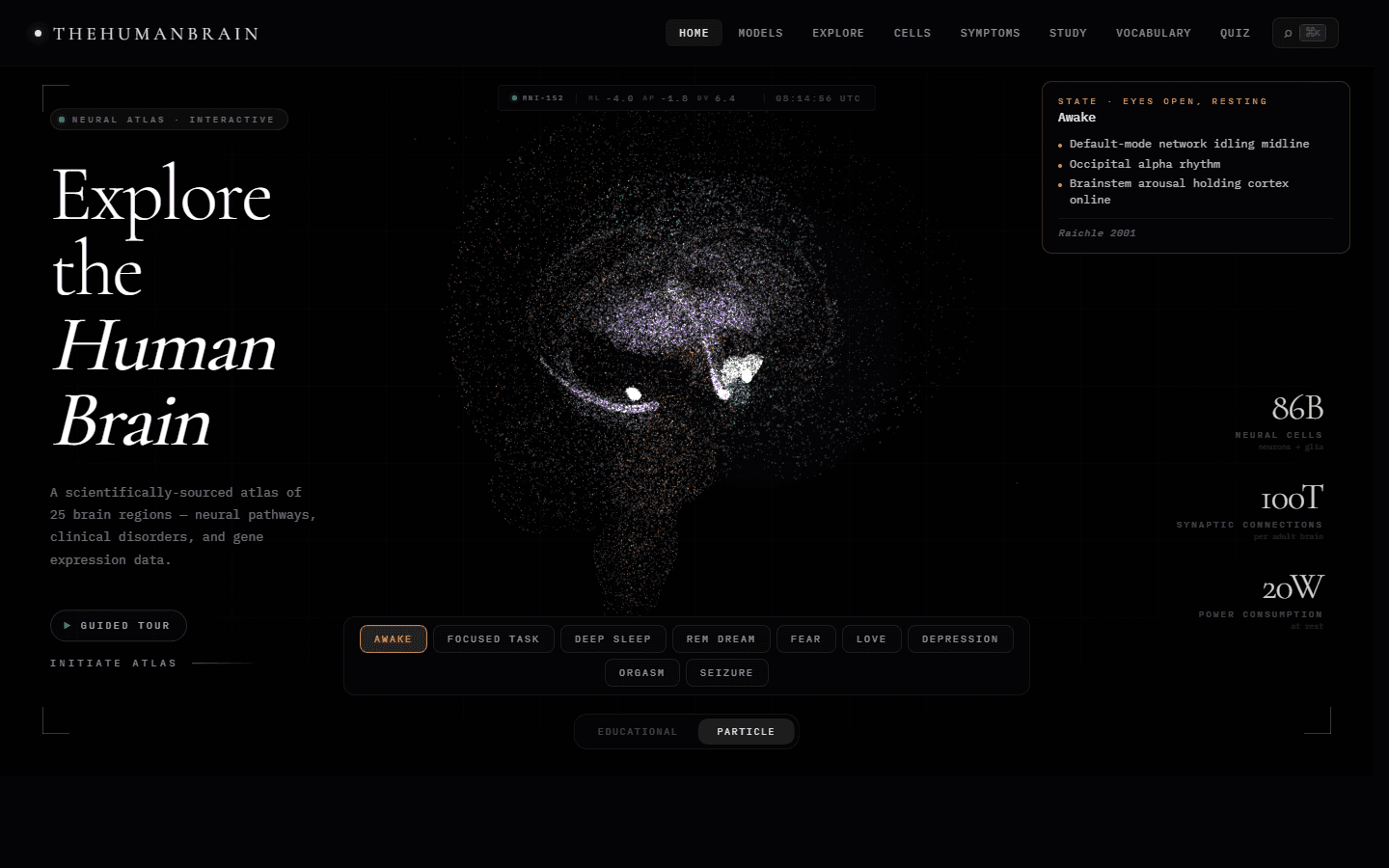
Twenty-five anatomical regions, rendered as GPU particles, animating through ten brain states from focus to seizure — backed by peer-reviewed literature.
- 25
- Anatomical regions
- 10
- Brain states
- 6
- Chapter levels
- 60fps
- On mid-range laptops
- React 19
- Three.js
- GLSL shaders
- Vite
Neuroscience that doesn't read like a textbook.
Most neuroscience explainers force you to choose between rigor and accessibility. Pop-science articles wave their hands; academic papers assume the vocabulary. The Human Brain tries to do both at once — a real anatomical reference that anyone can navigate, but with literature-backed depth for anyone who wants to dig.
The interactive 3D atlas is the centerpiece. Twenty-five regions from the Allen Brain Atlas are rendered as particle clouds. When you select a brain state — focus, REM sleep, fear, love, depression, seizure, and more — the particles light up in patterns that match what current research says actually fires in that state. It's a visual you can look at for a minute and walk away knowing something true.
GPU particles, GLSL shaders, and a lot of state choreography.
Each anatomical region is a particle system — somewhere between a few hundred and a few thousand points depending on the region's volume. All of them run on the GPU through custom GLSL shaders so the brain stays at 60fps even on a 5-year-old laptop. The particle positions come from the Allen Brain Atlas's volumetric data, downsampled and packed into vertex buffers at build time so the runtime doesn't pay the cost.
Brain states are the trickier part. Each state is a choreographed animation: which regions activate, in what order, at what intensity. Some states (focus, REM) are well-documented; others (love, fear) required pulling from multiple studies and reconciling overlapping claims. Every state has a citation trail in the chapter content.
The chapter system is six levels deep — from "what is a brain" up through specific peer-reviewed papers. Each level rewrites the same content for a different audience, so a curious 12-year-old and a neuroscience grad student can both navigate to something useful. Chapter content is in MDX so it can mix prose, citations, and inline 3D interactions.
What I'd do differently.
Two things, mainly. First, I spent a lot of time tuning the visual fidelity of each region individually — number of particles, falloff radius, color intensity — and in hindsight a more systematic approach would have shipped weeks earlier. The visuals are good now, but I burned days on micro-decisions that didn't move the needle.
Second, mobile. The site works on mobile but the 3D interaction is awkward on touch. A purpose-built mobile experience (maybe a 2D anatomical view with the same brain states) would have served the half of my traffic that visits on a phone. That's the next iteration.
The best way to understand it is to use it.